
We’ve all seen the infamous breakdowns live and in real time. Cocky. Hot Girls Read. Book Boyfriend. Blind Date With A Book. These are just the ones in recent memory. An internet search could likely reveal many, many more.
Trademark messes in the book world almost always involve independent authors, influencers, or small businesses trying to claim exclusive rights to common, everyday words or community phrases. When these individuals attempt to stop other creators from using these terms, it sparks massive online backlash, crowdfunded legal challenges, and platform bans.
So why do they do it? Well, there’s a lot of confusion about what can and can’t be trademarked or copyrighted, and even what you can do once you have the legal right to whatever you’ve claimed as exclusively ‘yours’. For some, it’s an innocent mistake. For others, a calculated marketing tactic. Sadly, a few use it to game the system or as a weapon against competitors.
The industry attracts all kinds, and as an indie author, you will see more of each of them over your years in the business. Let’s clear the confusion on the point of exclusivity first, then we’ll discuss when owning your own trademark becomes a good business decision for you, and why.
Copyrights
A copyright protects the creator of an original creative work and gives them exclusive control over its reproduction, distribution, and adaptations. It is automatic… copyright starts as soon as you write your book and put it into physical form. For creative works, this means putting it on paper, on a hard drive, or in the case of art- on canvas or another medium.
Copyright protects the text of your novel, the recorded song, or the completed artwork itself. It does not protect the ideas, the concepts, the research you used, or names/titles/short phrases.
Now, though in most countries copyright is automatic, it is not absolute. If you ever have to file a lawsuit for infringement, you will be out of luck if you haven’t registered with the copyright office. (At least in the US. Make sure to research your local laws!)
Many indie authors were caught unawares when our work was infringed on by AI scrapers, and we were left out of a large settlement because we believed we weren’t required to register. This was what we had always been told, but the courts dictated otherwise.
My advice? Scrape up the money to register at least one format you plan to publish in. I would rather not need it and have it, than to need it and not have it. I missed out on roughly $15,000 by believing I was protected automatically, and that is an error that will sting for a very long time.
Trademarks
The core difference between the two is that where copyrights protect the creative work itself, trademarks protect brand identities. The description is basically the name- trade marks, the marks that identify your trade.
Here’s where it gets murky. You can’t trademark generic terms, product designs, names, titles, or short phrases. Trademarks are specifically meant to combine several different elements to protect a brand from competitors and to protect consumers from confusion.
Trademarks are for series names, unique business names and logos, and ‘first use’ wins. That means… if it’s in common use, other people have used it for years, and you’re just hopping on the bandwagon? It ain’t gonna work, fam.
In the case of those above, “Cocky” isn’t a brand. It wasn’t a series. She didn’t add a logo with it, a series name to it, or anything to signify it was something unique. It’s just a common word. Same with all of the others… they’re just words, words used by many businesses in the book world for different things.
If you want to say they’re unique and a brand identity, you have to make it so. When registering a trademark, you should be adding everything you can… what it will be used for, the word/phrase you are using. The specific logo, symbol, and font you will be using, along with distinctive shapes, product designs, and colors if those apply. This protects you and others, as only your specific use and application will be trademarked.
So, when should I utilize a trademark?
Again, using the Cocky case. Her series was actually The Cocker Brothers, in a certain font, in a certain color. Had she trademarked that? No one would have batted an eye. She did own that. That was her series, her creation, and no one else had a claim to it. That is exactly what trademarking is meant to be for.
When you have a popular series or your business grows large enough to where you’re seeing people start copying elements of things you’ve done, (or worse, straight up stealing your content) this is the time to start thinking about applying for a trademark.
Let’s use a popular author, photographer, cover artist, and model friend of mine, Golden Czermak. His business is called FuriousFotog. People have been stealing his covers and photos for a long time, even removing his watermarks. With AI, this has gotten even worse. Obviously, with rampant theft, a trademark was in his best interest.
Now, looking at his publicly available registration, it is a wordmark. That means, this registration is just for his business name with no fonts or logos attached. However, when it asks what it will be used for, he has put down- Goods and services: IC 041: Photography; Photography services; Digital imaging services; Portrait photography.
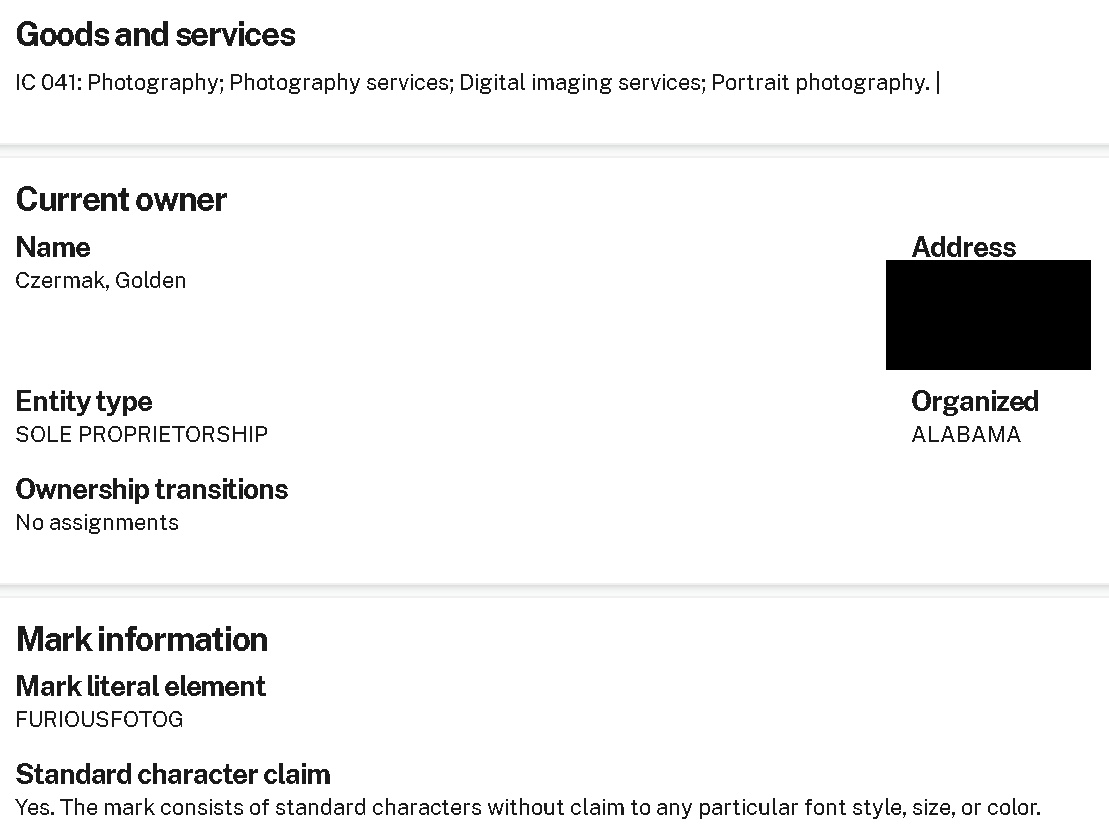
What does this mean? This means those are what his trademark covers. If he wanted to suddenly start making say… protein bars and supplements under the FuriousFotog name, he would have to apply for another trademark for that.
Your trademark covers only what you apply for and what you use it for. This matters, because it prevents situations like someone trademarking a common word or phrase, and no one else being able to utilize it.
That distinction is important, and protects many small businesses from threatened by larger corporations, because they’re making something completely different than what the larger business has trademarked, and therefore, consumer confusion doesn’t come into play and it doesn’t violate trademark.
A good example here is Delta Airlines versus Delta Faucets. They both exist and don’t violate each other’s trademarks because they are obviously very different businesses doing very different things.
Is it worth it?
I can’t tell you that. Trademarks can get expensive. First you have to file, but then there’s legal fees and search fees. Yes, you probably will need a lawyer knowledgeable about trademark law, because they have to search to ensure your trademark isn’t going to infringe on someone else’s trademark that’s already registered. If anyone files a takedown, your lawyer will need to fight that.
Then, if you get it registered, it takes constant upkeep and renewals. It also takes defense, which can often mean court cases to defend from someone using your trademark without even knowing they are doing so, along with constantly issuing takedown notices to anyone you see infringing on your trademark.
Wait, what do you mean, I have to defend it?
Oh yes. Remember the cases above, when all of them claimed they weren’t going to actively go after people, and the trademark was just for their own protection? That’s not how this works. The first business to use a trademark in a marketplace owns it against later users, because trademark laws and principles are designed specifically to settle disputes.
The Duty to Police (Lanham Act)- To maintain the validity of a trademark, owners must ensure their mark does not become a “generic” term. If third parties use the mark, the public may stop identifying it with a single source, weakening the brand.
Under Section 45 of the Lanham Act, a mark is deemed abandoned if its use has been discontinued with no intent to resume, or if the owner’s actions (or inactions) cause the mark to lose its significance. The law requires that a trademark is used continuously in commerce to maintain its protection.
Failure to actively monitor and enforce a trademark can lead to severe legal and financial repercussions. A court may rule that by failing to challenge infringers, the owner has abandoned their exclusive rights, allowing competitors to use the mark. If an owner waits too long to take action, they may lose the ability to stop an infringer.
Trademark owners are expected to take reasonable steps to protect their intellectual property. This includes monitoring the marketplace for infringing uses, sending cease-and-desist letters, and initiating lawsuits to stop unauthorized, confusingly similar use.
So no, those letters and takedown notices weren’t accidental. Those filing trademark applications ‘just to protect their brand’ weren’t being truthful. When starting the process of a trademark, they are told these things and know what is at risk and what they have to do to maintain their trademark. They all knew they were going to be taking aim at fellow indie authors, taking money from their own communities, and didn’t care.
This is why, if you decide your works or brand qualifies for a trademark, you need to be as specific as possible and ensure you’re applying for exactly what you intend to use it for. Otherwise, you will go down in BookTok infamy much like the rest of the horde has.
A Special Note About Graphic Elements
As we learned with the Cockygate debacle, when setting yourself up for a trademark filing, check your sources! Most graphics and fonts we download for free come with personal use licenses. We cannot use these on books or logos for commercial uses. When looking for elements for your business, you need to look for fonts and components that have commercial licenses. These are the ones that are allowed to be used for business purposes, like book covers and logos.
However, many have terms in the licenses that prohibit them from being used in trademarks, because they are owned and copyrighted by the graphic designer who created them. If you want to utilize a commercial element in a trademark filing, you MUST either find one that allows this, or contact the creator and ask if they will allow it.
They may, but many will require an additional fee for it. This is their right, as they are giving up their personal intellectual property for you to register a portion of it for yourself. Pay the artists what they’re worth or, like Faleena, you may find yourself having an uncomfortable day in court, as well.